

The CrossFit season creeps up fast. One minute you’re in a nice, steady off-season groove, and the next you realise the Open is only a few months away and you’re asking:
-
“Am I actually ready for this?”
-
“What should I be training right now?”
-
“Do I care more about my Open placing or about making Quarterfinals?”
This post breaks down how to prep smart based on who you are as an athlete – Open-focused, Quarterfinal-focused, or chasing Semifinals – plus practical strategy and mindset tips you can use straight away.
The Season at a Glance
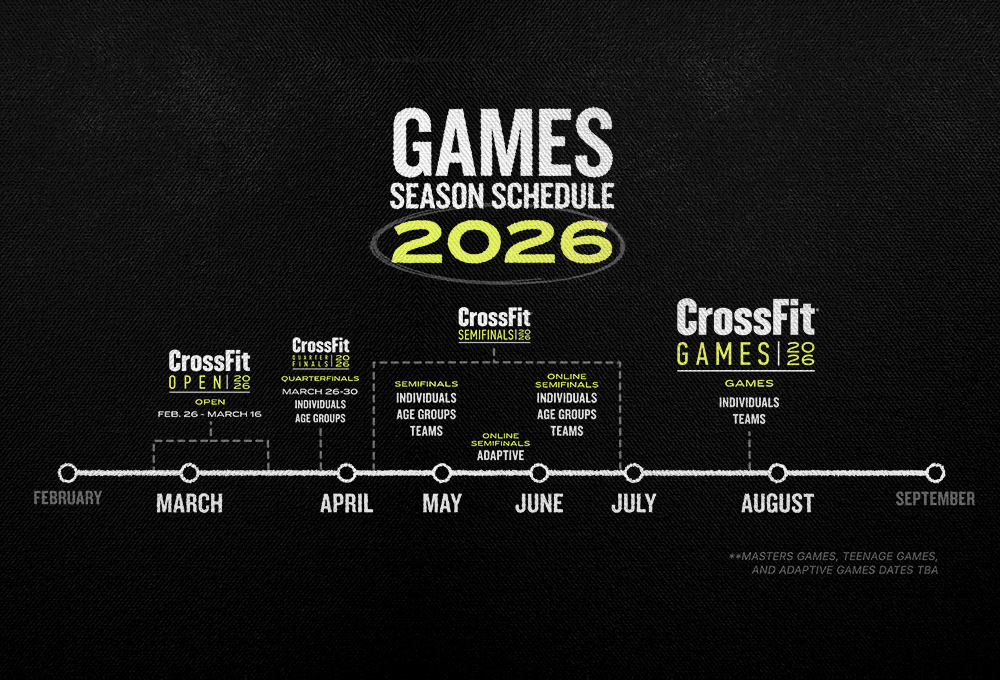
Before we talk strategy, it’s helpful to zoom out and look at the season structure:
-
The Open:
-
3 weeks
-
Most workouts are 20 minutes or less
-
Over half of all Open workouts historically fall in the 8–14 minute window
-
-
Quarterfinals:
-
You need to be in the top 25% from the Open to make it
-
More skills, more weight, more complexity, and often multiple hard workouts across a weekend
-
-
Semifinals (big picture):
-
More spots than ever, including more online opportunities for age group athletes
-
Realistically, it’s still the top slice of the sport – but more people than ever will get a shot to qualify. Qualify for the online semi finals or to do the qualifier for an in person semi final which will be managed third party by the individual events.
There dates can be found here
-
Your job: decide which stage is “your season” – Open, Quarterfinals, or Semis – and build your training around that.
Where You Should Be Right Now: From Off-Season to “Game Shape”
If the year has gone to plan, you’ve just wrapped up or are wrapping up a solid off-season strength/limiter block.
For most athletes, that means:
-
You spent time getting stronger.
-
You attacked your weakest areas in a more controlled, non-competitive way.
Now, you’re entering the bridge phase:
What the bridge phase should look like
-
Stop training weaknesses only in isolation.
-
Start integrating those limiters into actual CrossFit pieces:
-
If strict HSPU are a weakness, they start to show up inside EMOMs and metcons.
-
If barbell cycling is a weakness, it gets layered into Open-style workouts.
-
-
Add 1–2 Open or Quarterfinal-style workouts per week to “play the game” again.
“I didn’t do any limiter work… now what?”
If you’re reading this thinking, “I’ve just been doing regular classes and not targeting anything…” – it’s okay. It’s not too late, but you can’t fix everything at once.
-
Identify one or two big weaknesses (e.g. ring muscle-ups, handstand walking, heavier barbells).
-
Build short, focused skill blocks around those inside your week.
-
Keep:
-
Your strength work
-
Your general CrossFit conditioning
-
A little sport-specific exposure to Open-style workouts
-
What is your top priority for the CrossFit season
Your training and your expectations should depend on which bucket you’re in:
-
Open-focused / Trying to make top 25% for the first time
-
Quarterfinal-focused (you’ll comfortably qualify)
-
Semi-final hopeful (on the bubble for semis)
If Your Focus Is the Open (or Making Quarterfinals for the First Time)
This is you if:
-
You’ve never made Quarterfinals but want to sneak into that top 25%, or
-
You simply care most about your Open placing.
Prioritise Open-style movements
You want to be brutally good at the basics that almost always show up:
-
Double-unders
-
Toes-to-bar & chest-to-bar
-
Thrusters & wall balls
-
Burpees (in all their evil forms)
-
Rowing calories
-
Light-to-moderate barbell cycling
De-prioritise (for now):
-
Rope climbs
-
GHD sit-ups
-
Ring muscle-ups
-
Very heavy barbells
-
Long 30+ minute grinds
They’re great skills, but they’re Quarterfinal problems more than Open problems.
Train the right time domains
Most Open workouts are:
-
≤ 20 minutes, with the majority in the 8–14 min range.
So your training should reflect that:
-
Plenty of 8–15 minute pieces where you:
-
Keep moving
-
Manage your heart rate
-
Hold sustainable (but uncomfortable) pacing
-
How to structure your weeks during the Open
If you’re an Open-focused athlete, treat those 3 weeks like a mini “competition season”:
A simple template:
-
Friday: First attempt at the Open workout
-
Saturday: Movement practice & technique (low intensity, fix issues from Friday)
-
Monday: Retest (if you’re on the bubble or your first attempt was off)
-
Tuesday: Practice movements likely to show up next (e.g. if no thrusters yet… you know what’s coming)
-
Wednesday: Strength-focused day, low conditioning (keep strength without getting smashed)
Key priorities:
-
Practice retesting before the Open begins.
-
In January/early February, run a few Friday + Monday scenarios:
-
Exact retest, or
-
Similar patterns (e.g. deadlift/burpee Friday, power snatch/burpee Monday).
-
-
This teaches you pacing, warm-up, and recovery.
-
-
Protect your retest day.
-
Saturday’s training should improve your movement efficiency, not bury you.
-
Think: step-up drills, bar path work, transitions – not more brutal metcons.
-
If Your Focus Is Quarterfinals
This is you if:
-
You’re confident you’ll land comfortably inside the top 25%.
-
You care more about Quarterfinal performance than Open bragging rights.
Big principle: don’t chase the Open leaderboard
It genuinely doesn’t matter if:
-
You come 500th or 800th in a burpee/dumbbell workout
if… -
You crush the muscle-up, HSPU, heavy barbell, longer pieces in Quarterfinals.
Your training should reflect Quarterfinal demands:
-
Higher-skill gymnastics
-
GHDs and rope climbs
-
Heavier barbells & complex barbell cycling
-
Longer pieces and multiple hard efforts across a weekend
How to use the Open if you’re Quarterfinal-focused
Think of the Open as:
“A weekly test I complete on Friday” – not the centre of the universe.
A simple approach:
-
Friday morning: Do the Open workout once (no retest).
-
Friday later session: Do a Quarterfinal-style workout.
-
This lets you practice:
-
Two hard pieces in a day
-
Eating, fuelling, and recovering between sessions
-
-
-
Saturday–Wednesday:
-
Almost entirely Quarterfinal-style prep
-
Bias the skills, weights and formats you know are more common in QFs
-
Tapering
-
No full taper for the Open.
-
Treat the three Open weeks + the gap week as your 4-week peak into Quarterfinals.
-
Plan your real taper and peak for Quarterfinal weekend.
If You’re Chasing Semifinals
This is you if:
-
You were close last year (e.g. just outside the cutoff).
-
You realistically believe you can make Semis with a good year.
Understand the opportunity
With more semi spots available, this year might be your best chance to step up a level – especially if you’re:
-
Top-end age group
-
Or competitive in the 34-and-under field
Coaching and mindset for this level
A few truths:
-
Your Open placing might look worse on paper if you’re truly prioritising Quarterfinals and Semis.
-
That’s okay. Once:
-
Higher skills
-
Heavier barbells
-
More complex tests
come out, the leaderboard flips.
-
As an athlete, you need to expect that and stay calm.
Special note for Masters athletes
For Masters, especially older divisions:
“The healthy Masters athlete wins, not the broken one.”
In the final 4–6 weeks before Quarterfinals:
-
Prioritise:
-
Staying injury-free
-
Extra mobility and position work, especially overhead
-
Smart volume management on high-skill and heavy movements
-
Movements like overhead squats and squat snatches get very difficult if something is even slightly tweaked. The goal is to arrive at Quarterfinals healthy enough to actually express your fitness.
Quarterfinal weekend is your “Game Day"
If you’re unlikely to go to an in-person semi and your main shot is the online semi, then Quarterfinals essentially become your main event:
-
Be prepared to repeat workouts, if it meaningfully improves your chances.
-
Go in ready to empty the tank across the weekend.
-
Plan for a full week off afterwards – not light training, actual recovery.
-
Then run a short prep block into Semis if you make it.
Mindset: How to Stay Sane During the Season
Don’t define yourself by the leaderboard
The leaderboard is data – not your identity.
There are only two things you can fully control:
-
Effort – Did you genuinely give your best?
-
Execution – Did you pace, strategise and adjust as well as you could?
Everything else (workouts, life stress, judging standards, time of day) is outside your control.
Stay in your lane
-
If your focus is the Open, don’t compare your volume and training to someone peaking for Quarterfinals or Semis.
-
Different goals = different training decisions.
-
Don’t let someone else’s training plan make you feel behind.
Become a strategy nerd
If you want to be competitive, you have to learn strategy, not just “go hard”:
-
Film your workouts.
-
Take splits.
-
Note where you blew up or got stuck.
-
Practice:
-
Different break strategies
-
Different opening paces
-
Slightly different warm-ups
-
Most importantly:
Stop copying Games athletes from the Open announcement.
They’re playing a different game with very different engines and skillsets.
Use this season to build the next one
Whatever happens this year:
-
Ask: Which movements or formats scared me? Which ones blew me up?
-
Those are your limiters for the next off-season block.
-
The Open and Quarterfinals are feedback for your training, not a final verdict on you as an athlete.
Final Thoughts
Whether you’re:
-
Trying to break into top 25%,
-
Using the Open as a stepping stone to Quarterfinals, or
-
Taking a serious run at Semifinals,
the key is the same: train for the stage that actually matters to you.
-
Open-focused? Get brutally efficient at the classic CrossFit movements and time domains.
-
Quarterfinal-focused? Don’t sacrifice heavy, high-skill preparation just to impress the Open leaderboard.
-
Semi-focused? Structure your season so that you peak for Quarterfinals, stay healthy, and give yourself a genuine shot.
If you’re unsure which category you fall into or how to structure your weeks around your life and recovery, that’s exactly the kind of thing a good coach can walk you through.
You don’t need more chaos. You need a clear plan that matches your goal.
At GRIT Performance, your training is built entirely around you. Every plan is designed to align with your goals, strengths, and lifestyle — no templates, no shortcuts. Whether you’re building strength, refining skills, or preparing for competition, your coach will be with you every step of the way. This isn’t generic programming — it’s training engineered for your potential.

